
MR and BWR Grades: Matching Glue to Interior Conditions
Two glue grades decide whether an interior panel survives its room: MR for dry interiors, BWR where humidity and light water exposure are part of the programme. The commercial category page lists both, and contractors often standardise 12 mm and 18 mm thicknesses across office furniture, shelves and hotel fixtures.
Key takeaways
- MR (Moisture Resistant) suits dry interiors; BWR (Boiling Water Resistant) is specified for humidity and light water exposure.
- Thickness guidance runs 6–9 mm for backs and partitions, 12–15 mm for furniture and fixtures, 18 mm for heavy-duty work.
- Contractors often standardise 12 mm and 18 mm across a programme.
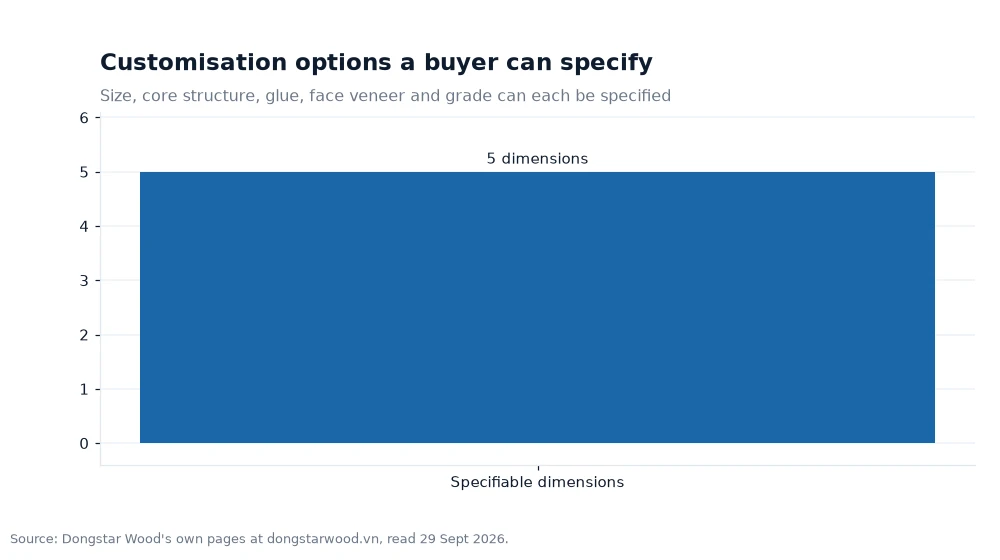
- The range is customisable across size, core structure, glue, face veneer and grade, with No Anti-Dumping Tax stated for the EU market.
What MR means on the page
The category page for Commercial Plywood describes the mill as a Vietnam plywood manufacturer whose specialisms are veneer plywood, hardwood plywood and furniture plywood, with custom and OEM plywood solutions alongside the standard range. Within that range, MR — Moisture Resistant — is the glue grade the page names for dry interiors: offices, bedrooms, retail fit-outs and any space where the panel faces stable indoor conditions rather than weather or routine wetting.
MR is not a coating or a surface treatment; it is the adhesive system bonded into the panel during pressing. That distinction matters for specification, because it means the grade cannot be upgraded after delivery — a panel pressed for a dry interior stays a dry-interior panel for its whole service life.
What BWR adds
BWR — Boiling Water Resistant — is the grade the page names for humidity and light water exposure. Kitchens, bathrooms, laundry rooms and utility spaces all sit in this band, as do shopfitting programmes where panels meet damp floors or steam cleaning. The grade describes the adhesive's resistance to moisture under the conditions the panel will actually meet, not a licence to submerge the board.
The practical question for a buyer is not "which grade is stronger" but "which room will the panel live in". A BWR panel in a dry office is money spent on a condition that never occurs; an MR panel in a humid room is a failure scheduled for the first wet season. The published guidance exists to keep those two mistakes apart.
Matching glue to the room
The matching exercise starts with the room, not the panel. List the spaces the programme covers, note which of them see humidity, steam, condensation or occasional splashing, and assign the glue grade space by space. A single hotel programme can legitimately carry both grades: MR for bedroom furniture and wardrobes, BWR for bathroom vanities, minibar cabinets and any panel near a wet area.
Where a programme straddles the line — a restaurant with a humid kitchen side and a dry dining side — the simpler rule is to specify BWR for the whole run. The grade is bonded in during pressing, so a single adhesive decision per production batch keeps the paperwork, the inspection and the installation consistent.
Thickness by application
Glue grade handles the room; thickness handles the component. The published bands put hidden parts at 6–9 mm, visible furniture at 12–15 mm and load-carrying panels at 18 mm, and most fit-outs settle on 12 mm and 18 mm because two gauges cover the majority of a job and simplify ordering, cutting lists and ironmongery.
The uses the page names — Furniture Plywood, Cabinet, Construction, Packing, Flooring — map onto the same thickness logic. A cabinet carcase wants 12–15 mm for shelf span and screw holding; a worktop or structural panel wants 18 mm for the load it carries; a back panel wants 6–9 mm because it carries almost nothing and saves weight and cost where nobody looks.
Faces, cores and the custom options
With glue and thickness fixed, the remaining choices are the face and the core. The face veneer list runs Rose Eucalyptus, EV, Bleached Poplar, Pine and Birch; the core list runs Combi Core, Eucalyptus Core, Bodhi Core and Acacia Core. The page lists custom options across size, core structure, glue, face veneer and grade, so a programme can hold one thickness and still vary the core and the face from batch to batch.
For EU buyers the page lists six reasons to source from this origin, among them a stable monthly supply, strong QC at each production stage, and a No Anti-Dumping Tax position for the EU market. Those reasons sit alongside the technical choices: the duty position affects landed cost, while the glue grade and thickness affect whether the panel survives its room.
| Glue grade | Published condition | Guidance | Typical use |
|---|---|---|---|
| MR (Moisture Resistant) | Dry interiors | Stable indoor conditions | Bedrooms, offices, retail fit-outs |
| BWR (Boiling Water Resistant) | Humidity and light water exposure | Kitchens, bathrooms, utility spaces | Vanities, minibar cabinets, damp-adjacent panels |
| 6–9 mm | Component thickness | Backs, drawer bottoms, partitions | Cabinet backs, lightweight dividers |
| 12–15 mm | Component thickness | Furniture, shelves, fixtures | Office furniture, hotel fixtures, shelving |
| 18 mm | Component thickness | Heavy-duty, worktops, structural | Worktops, structural panels, heavy furniture |
Worked example: area per sheet and per run
A carcase programme built from 1250 × 2500 mm sheets covers 1250 mm × 2500 mm = 3.125 m² per sheet, so forty sheets deliver 40 × 3.125 = 125 m² of panel before cutting losses. Moving from 12 mm to 18 mm adds 18 − 12 = 6 mm of thickness to every component in the run, which changes carcase geometry, hinge placement and the span a shelf can carry.
The glue choice follows the same arithmetic of consequences. If a bathroom vanity run of twenty panels is specified MR instead of BWR, the saving on unit price is real and the failure mode is deferred — it arrives with the first humid season, not at the invoice. Specifying BWR for the whole programme costs more per sheet and buys one adhesive decision that the whole batch shares.
Frequently asked questions
What is the difference between MR and BWR glue?
MR (Moisture Resistant) suits dry interiors, while BWR (Boiling Water Resistant) is the grade specified for humidity and light water exposure. The choice is made at the specification stage, because the glue class is bonded into the panel during pressing and cannot be upgraded later.
Which thickness should a cabinet programme standardise on?
The programme standardises on 12 mm and 18 mm: the first covers furniture, shelves and fixtures, the second worktops and structural parts. Anything thinner — 6–9 mm — is reserved for backs, drawer bottoms and partitions, the hidden parts that carry almost nothing.
Can size, core and face veneer be customised together?
Yes. The category lists custom options across size, core structure, glue, face veneer and grade, so a programme can fix one thickness and still vary the core — Acacia, Bodhi, Eucalyptus or Combi — and the face veneer, from Birch and Pine to Bleached Poplar, EV and Rose Eucalyptus.
From glue grade to finished interior
With the glue grade fixed to the room and the thickness fixed to the component, the remaining choices are cosmetic and structural. Compare the birch plywood range where a uniform light cream to pale brown face matters, or the film faced category where the panel has to survive a construction site rather than a showroom. The same mill presses both, which is what makes a single specification sheet cover a whole project.
The data behind this article was taken from the manufacturer's pages at dongstarwood.vn checked 29 Sept 2026[1].