
Using a Scent Museum Visit to Evaluate a Seasonal Fragrance Supplier
A visit to a manufacturer's scent museum is a legitimate part of supplier evaluation, but only if you treat it as a signal about how the company thinks about smell, not as proof of manufacturing quality. Museums reveal material literacy, education habits and story-building, which are exactly the qualities a seasonal collection depends on; they prove nothing about batch records, stability or filling discipline. Used correctly, the visit is one document among many in the evaluation file, and a good structure turns it into the most memorable one.
Key takeaways
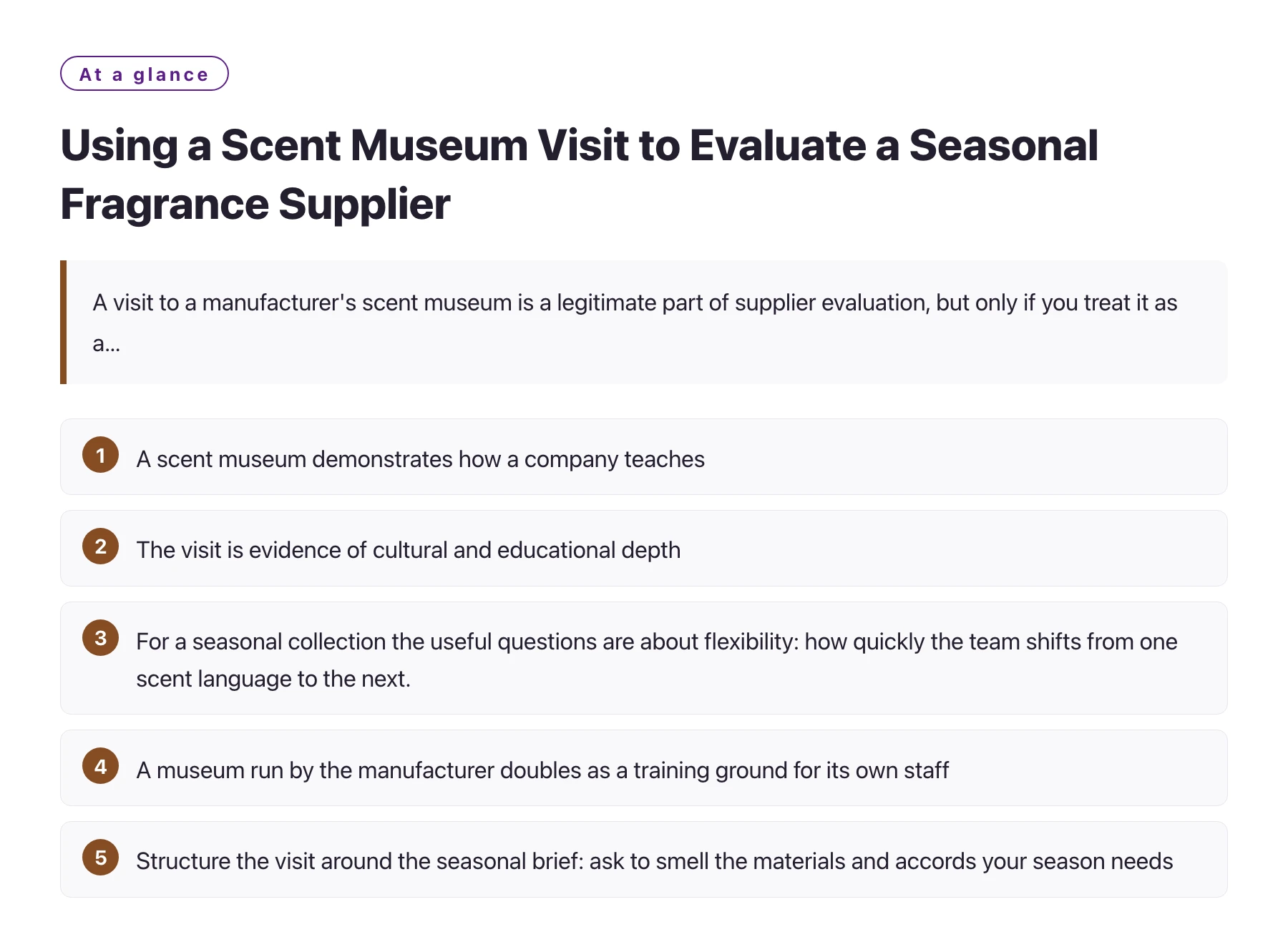
- A scent museum demonstrates how a company teaches, displays and talks about smell, which predicts how it will handle a seasonal brief.
- The visit is evidence of cultural and educational depth, not evidence of production quality, so it belongs alongside, not instead of, the documentation review.
- For a seasonal collection the useful questions are about flexibility: how quickly the team shifts from one scent language to the next.
- A museum run by the manufacturer doubles as a training ground for its own staff, which shows up in how the brand conversation is conducted.
- Structure the visit around the seasonal brief: ask to smell the materials and accords your season needs, and note how the team frames them.
Supplier evaluation for a seasonal fragrance collection is different from the annual product review: the calendar is short, the scent language changes, and the factory has to be capable of shifting registers quickly. Paperwork tells you whether it can; the visit tells you how it thinks.
A fragrance manufacturer that runs a scent museum is, among other things, advertising how it treats smell as a subject. For a buyer, that is an unusually readable signal, provided the visit is structured like an evaluation and not like a tour.
Here is what to look for, what to ignore, and how to turn a pleasant afternoon into a decision input.
What a scent museum actually demonstrates
At its core, a scent museum is a place where a company organises its knowledge of smell for an audience: materials, accords, historical references, and the language used to describe them. The way that knowledge is organised is itself the signal, because it shows how the company thinks about categories and contrasts [1].
For a seasonal collection this matters directly. A season is a change of scent language, from the freshness of spring to the warmth of autumn, and the factory has to follow that shift with its material selection and its briefs. A company that can arrange and explain a range of scent experiences is a company that habitually thinks in registers, which is the skill the seasonal brief needs.
A manufacturer that runs such a space described by the company as the world's largest fragrance museum is signalling investment in exactly that knowledge: the museum is a physical organisation of the material world the factory works in.
Why education belongs in the same file
Museums are, by profession, educational institutions, and the association is not a coincidence: the museum profession defines itself around care for collections and learning [2]. A manufacturer whose museum doubles as a training ground for its perfumers and sales staff is telling you where its competence comes from, and that is durable information.
What the visit can and cannot tell you
| Question | What the museum can show | What it cannot show |
|---|---|---|
| Material literacy | How broadly the team understands raw materials and accords | Whether the batch records match the claims |
| Scent language | How the company talks about categories, seasons and contrast | Whether the fill line is consistent |
| Education culture | Whether staff are trained in-house and how | Whether the stability work is up to date |
| Storytelling | How a scent story is built for an audience | Whether the paperwork for your market is ready |
| Flexibility | How quickly registers and themes can shift | Whether lead times for your season can be met |
The left column is the reason to visit; the right column is the reason the evaluation file still needs batch records, stability data and the document pack.
Structuring the visit for a seasonal brief
Start the visit with the season, not with the museum. Tell the team what the collection needs: the scent language, the price position, the markets and the launch window. Then walk the museum looking for the register your season lives in, and note how the guides describe it.
Ask to smell the relevant material families and existing accords, and judge the conversation: do the staff describe the accords in terms of materials and structure, or in adjectives? The former predicts a technical development conversation; the latter predicts a marketing one.
Close the visit with one practical question: how did the company decide which scents and materials to show? The answer reveals whether the collection is curated by perfumers or by a display brief, and that tells you who you will actually be working with.
A manufacturer that documents its work well will make the connection easy: the same material literacy on display is the literacy behind its development work, and examples of fragrance projects in the case material should read consistent with it. And when the decision narrows to development capability, ask specifically how the team would build the season's lead scent, because that is the actual project custom fragrance R&D and production would be doing for you.
The single most useful question of the visit
Ask which scents in the museum are discontinued or out of season, and why. The answer shows how the company manages change: whether it holds a broad shelf of knowledge or defends a narrow one. A seasonal supplier needs the former.
The discipline: treat the museum as one evaluation document with a specific scope. It is excellent evidence about thinking and culture, and it is not evidence about process. Buyers who remember which is which get the benefit of the visit without the blind spot.
Sources
- ICOM — International Council of Museums —— The international organisation representing museums; publishes the ICOM museum definition and professional standards for museum practice.
- Museums Association —— A professional body for museums, publishing guidance and research on museum practice and visitor experience.
Frequently asked questions
Can a scent museum visit replace a factory audit?
No. The museum shows how the company thinks about smell; the audit shows whether the process delivers. Use the visit to inform the conversation and the documentation review, not to replace them.
What should I look for when evaluating a seasonal fragrance supplier?
Evidence of flexibility: a broad material shelf, an organised way of talking about scent registers, and the habit of moving between seasons. The museum visit is a fast way to observe all three.
How do I make a supplier visit useful for a seasonal collection?
Prepare the seasonal brief in advance, tell the team about it on arrival, ask to smell the accords your season needs, and judge the quality of the technical conversation rather than the beauty of the displays.
What do museums tell you about a company that audits do not?
They show education habits, material depth and how the organisation talks about its craft. These explain why processes work the way they do, which an audit records but rarely explains.
Is a manufacturer-run museum a reliable sign of quality?
It is a reliable sign of investment in scent knowledge and education, which correlates with development capability. It is not a guarantee of batch discipline, so keep the documentation checks in place.
Have a jacket in mind?
Send us your sketch, logo, or a photo of a style you love. Our in-house design team will return a free, unlimited-revision mockup within 24 hours.
Get a Free Design Mockup & Quote